When Should You Remove a Tree in Castle Rock, Colorado?
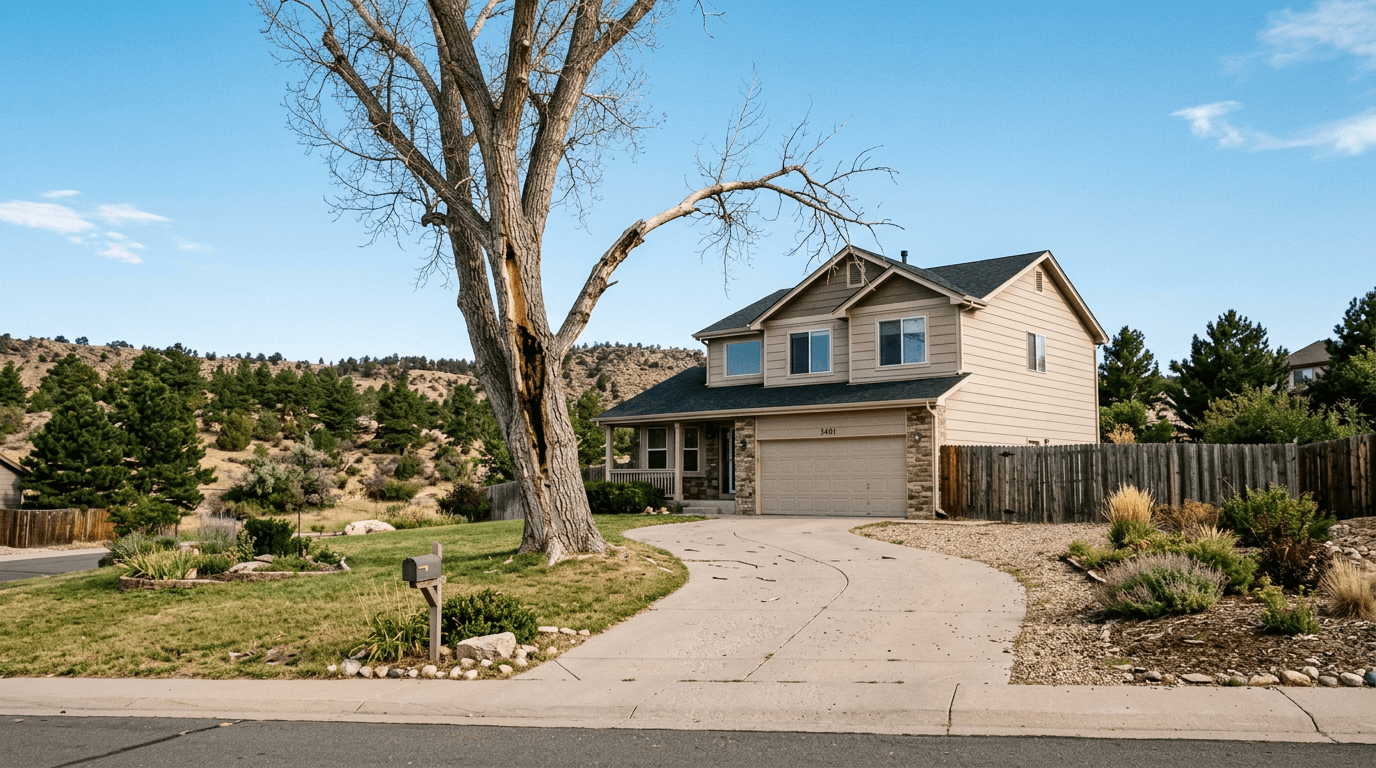
Illustrative image — not a completed High Plains project.
Tree removal in Castle Rock, Colorado
Trees are a big part of what makes a Castle Rock property feel like home. They shade the house, give the yard some privacy and soften the look of the whole street. They also take a beating here. In a single year, a tree in Douglas County might deal with a wet spring snow that loads every branch, summer thunderstorms, long dry stretches, gusty winds coming off the foothills and big temperature swings from one day to the next.
Over time, that stress shows. That's why it's worth walking your property once or twice a year — after the leaves drop in the fall and again in spring — and taking an honest look at the trees near your house, driveway, fence, deck and anywhere your family spends time outside.
One thing to keep in mind before reading the list below: not every damaged or unhealthy tree needs to come down. Plenty of trees can be pruned, cabled or simply monitored. The signs below are reasons to take a closer look and, when in doubt, get a professional opinion. If you're unsure whether a tree is healthy, a qualified arborist is the right person to diagnose it. When removal is the answer, that's where a residential tree removal crew comes in.
7 warning signs a tree may need to be removed
1. Large dead branches
Dead limbs are brittle and don't flex the way living wood does. A large one can snap without much warning in a strong wind or under the weight of wet spring snow — and if it's hanging over a roof, driveway, play area or walkway, that's a real safety concern. Dead branches are usually easy to spot: no leaves in summer, bark peeling away, or wood that looks gray and dry.
A few dead branches don't mean the tree is finished. Often, professional pruning to remove the dead wood is all that's needed. It becomes a bigger concern when a large share of the canopy is dead, or when the dead limbs are major structural branches.
2. Significant trunk damage
The trunk carries the weight of the entire tree, so damage there deserves attention. Watch for deep vertical cracks, large cavities or hollow spots, sections of missing bark, mushrooms or fungal growth at the base, or soft, crumbly wood. A trunk that splits into two main stems with a crack at the joint can also be a weak point.
That said, visible damage doesn't always mean removal is necessary. Many trees live for years with old wounds or small cavities. How much sound wood remains matters more than how the damage looks, which is why an arborist's evaluation can be worth it before making a decision.
3. A tree is suddenly leaning
Lots of trees grow with a natural lean toward the sun, and a tree that has leaned the same way for years is not necessarily dangerous. What gets our attention is a lean that's new or getting worse — especially after a storm or heavy snow. Look at the ground on the side opposite the lean. Cracked or heaved soil, a raised mound or roots lifting out of the ground can mean the root system is losing its grip.
A tree that has started leaning toward a house, garage or power line should be looked at promptly rather than waiting to see what happens.
4. Root damage or uprooting
Roots are what keep a tree standing, and they're easy to forget about because most of them are out of sight. They can be damaged by trenching for utilities or sprinklers, by digging for a new patio or driveway, by soil being piled up around the trunk, or by rot. Signs of a problem include exposed roots that are cut, broken or decaying, fungus growing near the root flare, or soil that seems to lift when the tree moves in the wind.
If you're planning concrete or landscaping work near a mature tree, it's worth thinking about the roots before anyone starts digging. A tree with badly damaged structural roots can become unstable even if the canopy still looks healthy.
5. Severe disease or decline
Some trees decline slowly. You might notice the canopy getting thinner each year, leaves that are small, discolored or dropping early, branches dying back from the tips, or a lot of new shoots sprouting from the trunk and base. Insects, disease, drought stress and old age can all play a part.
Because so many different things can cause these symptoms — and some are treatable — we recommend having a qualified arborist evaluate the tree when the cause or severity isn't clear. If the tree is too far gone or has become a hazard, removal may be the safest choice, and it can also keep a problem from spreading to nearby trees.
6. Storm damage
Castle Rock gets its share of hard weather. Heavy, wet snow in spring and fall is especially tough on trees that still have their leaves, and high winds and summer thunderstorms can tear off limbs or split trunks. After a storm, look for hanging or broken branches (sometimes called hangers), split trunks or major limbs, and trees that have shifted or partially uprooted.
A tree that has lost a few limbs can often be saved with careful pruning to clean up the broken wood. Removal makes more sense when the main trunk is split, a large portion of the canopy is gone, or the tree has started to uproot.
Safety first: if a tree or branch is touching or tangled in a power line, stay well away from it, keep kids and pets back, and contact your electric utility provider right away. Never try to move or cut a tree that's in contact with power lines yourself.
7. A tree is threatening structures
Trees growing close to a home, garage, fence, driveway or sidewalk can cause problems over time. Branches rub against roofs and siding, limbs hang over the house, and in some cases roots contribute to lifted or cracked concrete — something we see often in our concrete repair and concrete replacement work.
Being close to a structure alone doesn't automatically mean a tree needs to come down. Healthy trees near houses can often be managed with pruning. Removal becomes worth considering when a tree is unhealthy or unstable and in a position to fall on something, or when it's causing ongoing damage that can't reasonably be managed another way.
How much does tree removal cost in Castle Rock?
There's no one-size-fits-all price for tree removal, because every tree and every yard is different. The main things that affect the cost include:
- Tree height and trunk diameter — larger trees take more time, labor and equipment.
- Tree condition — dead, decayed or storm-damaged trees can be less predictable to take down safely.
- Accessibility — a tree in an open front yard is simpler than one in a fenced backyard with no equipment access.
- Proximity to structures — trees near homes, fences, power lines or other trees may need to be removed in small sections.
- Equipment requirements — some jobs need climbing gear, rigging or specialized equipment.
- Debris hauling and cleanup — removing limbs, logs and brush from the property adds to the scope.
- Overall complexity — multi-trunk trees, heavy leans and tight spaces all make a removal more involved.
The most reliable way to know what your project will cost is to have someone look at it in person. We're happy to come out and give you a straightforward, personalized estimate — just request a free estimate.
Can you remove a tree without a permit in Castle Rock?
It depends on where the tree is and what rules apply to your property. Trees on private residential lots are generally treated differently from trees in the public right-of-way, such as between the sidewalk and the street. Many Castle Rock neighborhoods also have HOA covenants that cover tree removal, and some properties may have additional restrictions tied to their location, open space or other protected areas.
Rules can change, so before removing a tree, check with your HOA and with the Town of Castle Rock (opens in a new tab) to confirm what applies to your property. If your home is outside town limits, check with Douglas County instead.
Why choose High Plains Concrete & Contracting?
High Plains Concrete & Contracting is a family-owned residential contractor based in Castle Rock, serving homeowners across Castle Rock, Parker, Highlands Ranch, Colorado Springs and the surrounding Front Range communities. Homeowners call us for residential tree removal, and many of them also know us for concrete driveways, patios and repairs, interior and exterior painting, kitchen and bathroom updates, decks and general home improvements.
When you call about a tree, here's what you can expect: we'll come out, look at the tree and its surroundings, talk through your options and give you a clear, straightforward estimate. During the job, we take care to protect your home, lawn, fences and hardscape, and we clean up and haul away the debris when we're finished, so your yard is left neat.
And if removing a tree is the first step toward something bigger — like replacing a driveway that roots have cracked — we can help with that too. Our article on why concrete driveways crack in Castle Rock explains what to look for.
Frequently asked questions
How do I know if a tree needs to be removed?
Common warning signs include large dead branches, major trunk cracks or cavities, a new or worsening lean, damaged or lifting roots, widespread decline and serious storm damage. Many of these issues can be managed with pruning, so if you're unsure, have the tree evaluated by a qualified arborist or a professional before deciding.
How much does tree removal cost in Castle Rock?
Cost depends on the tree's size and condition, how easy it is to access, how close it is to structures, the equipment needed and how much debris has to be hauled away. The best way to get an accurate number is an in-person estimate. High Plains offers free estimates.
Can a dead tree be left standing?
Sometimes. A small dead tree far from homes, roads and gathering areas may pose little risk. A dead tree near a house, driveway, fence or walkway is more concerning, because dead wood becomes brittle and can fall unexpectedly, especially in wind or snow.
Is winter a good time to remove a tree in Colorado?
Late fall and winter can be a good time for many removals. Without leaves, the tree's structure is easier to see, and frozen ground can help protect lawns and landscaping. Hazardous trees should be dealt with whenever they become a risk, regardless of season.
Do I need permission to remove a tree on my property?
It depends on your property's location, HOA rules and applicable town or county requirements. Trees in the public right-of-way are typically treated differently from trees on private lots. Check with your HOA and the Town of Castle Rock (or Douglas County) before removal.
Can storm-damaged trees be saved?
Often, yes. Trees that have lost some limbs can frequently recover with proper pruning to remove broken wood. Removal is more likely when the main trunk is split, much of the canopy is lost or the tree has begun to uproot. Stay away from any tree touching power lines and call your utility provider.
Need a Tree Removed in Castle Rock? Request a Free Estimate.
Get a free, zero-obligation quote from a licensed, family-owned Colorado contractor.